Showing posts with label Urban Vignettes. Show all posts

Tuesday, July 31, 2012

Urban Vignettes Week 8: Diversity is Diverse

I think that when people think of diversity, in America at least, most people point out the colors of our skin, or the languages that we speak. True, that's a part of it. But I'm not here today to talk about that. I think I touched a little on Detroit's racial composition in the first weeks, and the difference in the suburbs of Detroit. But today I want to think differently: Detroit as a city of diverse places/spaces and economic structures. 


Eastern Market on Flower Day
When I think of economic diversity (or dichotomy) in Detroit, I think of the paleterias ambulantes in Southwest Detroit contrasted with the soaring towers of the auto industry in the Renaissance Center in the heart of Downtown Detroit. What comes to mind are the stark difference between a Meijer or Kroger (major supermarket chains) and the authenticity and rawness of the Eastern Market. 
Packard Plant Spring 2012
When I think of diversity of spaces, I think of our well tended River Walk, and our deserted, overgrown playgrounds. I envision our blocks upon blocks of abandoned lots, where houses once stood, contrasted by our many historic districts. I think of the fires that constantly plague the poorest districts in town as abandoned houses are burned out of desperation, accidental fires in homes of the poor or crumbling homes and industrial buildings. While only a few blocks away are thriving neighborhoods with new developments. 
Smoke from a House Fire
I think of the spaces that are polished and kept afloat with money, and the others that are surviving on the hard work and determination of neighbors.
Skillman Foundation Office Building
A Brightmoor Community Garden & Salvaged Garage
Detroit is diverse in venues - you can go see a world class opera or orchestra performance in a hall with impeccable acoustics, or go to something like the Detroit Night Market, which operates out of the backs of moving trucks in an abandoned field.
Detroit Night Market 2012
There is no end to the possibilities that Detroit can offer. You can live in a burned out home that you've restored. You could live in a mansion owned by a former world-renowned record label owner. 
Burned Home in Corktown

The Motown Mansion
The fact is, we live in Detroit. This is the home to people, businesses, and spaces that are as diverse as our population is numerous. We are all different, and yet, we all live here together.


Sincerely,

Kaity Nicastri, Detroit Lover

If you want to see the post in other formats, go to Urban Vignettes.

Saturday, July 21, 2012

Urban Vignettes Week 7: Signs

Signs of Another Reality


When I look at the signs that I pass on a regular basis, it initiates a train of thought about the dynamics of politics, social structures, and economics in Detroit. 

Let's start with the following signs:
The first on the top left is between two thriving neighborhoods: Mexican Town and Corktown. The idea of a car that cost $10,000+ at some point being sold at 1% of its value or less is strange - the disposable nature of such a core part of our economy in the US, and especially Michigan, is ironic. Is our economy also disposable?

The large picture is of a construction sign that appears temporary, but has been present for nearly half of my life. The Detroit International Bridge Company has been "working" on a project with the Michigan Department of Transportation to alleviate bridge traffic and decrease truck traffic in the neighborhoods, but they did not live up to their end of the bargain. This led to the two executives of the company to be jailed for a night, and at least part of the project was completed quickly thereafter. The Ambassador Bridge is the property of Manuel J. Moroun, a Detroit suburban billionaire who owns a trucking empire, It is one of only two privately owned bridges along the United States’ entire northern border and by far the most economically significant privately owned bridge in the nation. It makes me question who really controls the economic culture of the largest city in Michigan.

The middle left reflects the growing culture in Detroit of growing our own food to combat the issues of being a "food desert" - fresh fruit and vegetables are hard to come by. Urban agriculture has been a way of taking ownership of health and food in a city once listed as the fattest in the United States. Growing our own food has been a way to reclaim land, and our health.

Lowest on the left: this type of sign is seen all over Detroit. I think of it as larger than just the building: Detroit is for sale and can be built to suit the needs of a family, business, or community. In Detroit, the only real limits for the future are your imagination.

Another set of signs I want to address are those of social and community trends:

Working clockwise from the top left: Gang Signs spray painted on a disused mechanic garage. 1/2 signs of the Southwest neighborhoods - one was ripped down. The highway signs that mark our Motor City and direct our primary product (cars) through the city. The signs of homeless men and women are all over the city - they are a sign and reminder that our economic plan does not include everyone as a general rule. These are signs that are present in many cities throughout the nation and world, but the backdrop changes.


The signs of Detroit show our character; our strengths and weaknesses. Our direction is defined by how we interpret the instructions found on each one.

Sincerely,

Kaity Nicastri, 
Detroit Lover


If you want to see the post in its edited form, go to Urban Vignettes.

Friday, July 6, 2012

Urban Vignettes Week 5: Sounds of Detroit

Sounds of Detroit

Looking down from an attic door in Detroit
Shhhh.... do you hear that? I hear the trucks sucking air past them in a rumble mixed with the rush of cars, the buzzing of motorcycles, and I haven't even left my bedroom yet.

I go to a recently un-abandoned house a few streets away for an art exhibit and social gathering.

I hear music on the radio, the hum of voices mixing together into a lively chatter, I step out of the back door of the garage and the party fades out, the birds chirping nearby begin to be louder, and the crackle of brush and broken glass under my feet take precedence in my auditory system.

I come back inside to watch a friend pump beer out of a keg.

On a sunny Monday afternoon, I venture to a favorite getaway: Belle Isle. There I wander along the inner roads to listen to birds, the wind, and the whirring of crickets and cicadas. 

This is my city, and these are its sounds.


You may have to turn up the volume for this, as I didn't have the proper equipment to capture the sounds, but I hope they will give you a sound idea of the Motor City.

Sincerely,

Kaity Nicastri,
Detroit Lover

If you want to see this post in its edited format, go to Urban Vignettes.

Friday, June 29, 2012

Urban Vignettes Week 4: Psst...! Detroiters Care a Whole Awful Lot...

Psst...! Detroiters Care a Whole Awful Lot...

Trailhead at Gratiot
I know, I know, you wanted to hear about clandestine meetings and hidden stories. I don't know very many of those, but I do know places I love to retreat to, and they are nearly always out of doors. One of Detroit's hidden stories is that it is a city of outdoor spaces and opportunity to expand them.

Detroit likes to reinvent the wheel. One place I love in the city is the Dequindre Cut. Formerly an abandoned railroad bed, it is now a roughly 1-mile pathway cutting through the heart of the city leading from Gratiot near the Eastern Market to the River Walk. 

On any given day you can see families biking or walking, youth skateboarding, runners, walkers, bikers, couples holding hands, and children scampering between overhead railroad tracks.

I particularly love the aerosol art and graffiti that line the path and uniquely mark it as a part of everyone's Detroit - the tidy and the messy, the formal and informal, the obvious and the underground.
One of my favorite pieces on the Cut.
This place invites you play, to remember that we are a big city, and to nurture the place with unity and love.
Play at Dequindre Cut
A completely different refuge and oasis in the city of cars and controversy is Brightmoor's Farmway.
Brightmoor Farmway House Board
Brightmoor is both a retreat and an inside story. This neighborhood is on the western border of Detroit; it has a rocky past, and a very hopeful present. Around the same time that residents in this neighborhood were involved by a program I previously worked for (community+public arts: DETROIT), they realized there was a LOT that could be done to make everyday life better. Determined residents created a "Farmway", with various gardens and community spaces created with limited resources that resemble a series of parks. Activities are led in these spaces, abandoned houses (like the one above) are converted into works of art and/or community places.

Anytime I need a little inspiration about the determination and sheer willpower of Detroiters, I go to the Farmway. I feel like a part of the community after attending meetings and watching them grow and promote their greenway. This area resembles the country, or even mid-Southern states with the larger lots, with many yards backing up to the river. It exudes a sense of peace, but the message I always come away with is this:
"Unless someone like you cares a whole awful lot, nothing is going to get better. It's not."
This message from Dr. Seuss' The Lorax has profound meaning in this neighborhood, especially since it is written on the local elementary school that was close a few years ago. In Detroit (or anywhere), if you don't care a whole awful lot, nothing gets better.

Sincerely,

Kaity Nicastri,
Detroit Lover

If you want to read the edited blog post, go to Urban Vignettes!

Friday, June 22, 2012

Urban Vignettes Week 3: The Motor Family

The Motor Family

Family Life

Although family is a general universal concept, it means something entirely different to me than to the guy that lives next door.

When I was really little, I thought family meant just the people in my house. As I grew, I realized all the people who came over for dinner occasionally, and whom I saw every holiday, were also family. At a family reunion with my mom's grandfather's children, grandchildren and great grandchildren family expanded to hundreds of people I didn't even know, but was connected by this one person.
Grandma dancing.
When I was 10, my maternal grandfather and grandmother came to live with us so my mom could care for her dying father. Then I learned that family means you take each other in, even if they lived far away before. In high school, a sister moved home to pursue a graduate degree. My oldest sister divorced and moved in with her two children. My brother finished college and moved home for a year to save money for a house. With nine people in the house, I realized that family is not static or linear. It contracts, expands and evolves over time.

My second oldest sister moved away to Florida when I was in middle school and she returned for a few months when I was in college between moving to Paris and moving permanently to Switzerland. We see her son only through Skype, aside from the occasional visit. I've lived in Chicago, Michigan’s Upper Peninsula, Chile, and Italy, and I visited my sister in Switzerland. My brother lived in Germany for two years. Communicating across the globe has become familiar to our family, even for my two 90+ years old grandmothers. I would disagree that families are breaking down; more so breaking out and relearning how to respond to a globalized economy.
Grandma Nicastri at Christmas with her great-grandchildren.
We preserve our traditions in Christmas festivities - we each contribute a dish from our various cultural backgrounds for our big Christmas Eve dinner. in 4th of July BBQs, Easter egg dying and egg hunts, in birthday parties/dinners, weddings, and other small holidays throughout the year.
Annual Christmas Sibling Photo
I wouldn't trade my unique family evolution for anything. I have been a youngest child, an only child, a middle child, and an oldest child; an aunt, a friend, a cousin, a sister-in-law. a granddaughter, and a daughter - all whilst living among my family.

Family Wedding Portrait
Sincerely,

Kaity Nicastri,
Detroit Lover

If you want to read the original post, go to Urban Vignettes.

Saturday, June 16, 2012

Urban Vignettes Week 2: Party Detroit Style


Every city has its own traditions, and Detroit likes to rock out hard. There are celebrations and festivals all year round -- the first International Auto Show in Cobo Hall, runs on Belle Isle on New Year's Eve in the bitter cold, and the Turkey Trot on Thanksgiving morning before the Thanksgiving Parade are old favorites, but there are smaller traditions growing, as well as trendsetting music festivals.

DEMF Logo 2012
To exemplify the big, the weird, and the communal, I have picked three Detroit celebrations. Firstly, the DEMF or Movement. Detroit Electronic Music Festival is every Memorial Day weekend (3rd weekend in May) and takes over Hart Plaza in the heart of Downtown Detroit on the riverfront. This festival started in 2000 and is a celebration of techno and electronic music in the birthplace of it all: Detroit. People from around the nation, and even the world come to hear the latest DJs and electronic masterminds spin and create. {Picture: DEMF Logo]

A completely different celebration, and entirely local movement, is the Marche du Nain Rouge. An event hailing back to when Detroit was still a French colony, locals dress in red and various costumes and create a ruckus to drive out du Nain Rouge (the Red Dwarf). It is held annually on the Saturday closest to the Vernal/Spring Equinox. A laid back and highly localized festival, the Marche brings people in costumes of devils, saints and natural elements. The goal: To banish the red-tinged, evil spirit that, according to legend, has haunted and troubled Detroit for three centuries. You can make your own effigy with your positive goals for Detroit: 
Make your own Nain Rouge effigy!

Photo Credit: Metromix 2011
Thirdly, and the last for this post, the Dally in the Alley is an example of neighborhood building that grows in popularity each year, and brings neighbors out to create a more unified city. This festival is simple but it creates a space of safety, creativity, and neighborliness that is crucial for residents. It is a block party - the neighborly tradition in cities and towns across America. A small, FREE celebration with arts, music, food, beer and fun, it brings crowds of people that are new and old to the city. It's a great way to meet people and see the inside story of the city. [Picture: Dally 2011, credit Metromix} 

Dally in the Alley Poster
The Dally is held around Labor Day, in early Fall/September, each year, and always holds the promise of new friends with old neighbors.

When you get Detroit, you get the quiet parties in backyards, the loud festivals in public spaces, and the ridiculous traditions in side streets. You also get the tech, the auto, the art, and the music, and the beauty of tradition. When you're here, you become part of the Detroit community, the family, the small town feel in a big city place.


Come party with us.


Sincerely,

Kaity Nicastri,
Detroit Lover

If you want to read the original post, go to Urban Vignettes! 


Disclaimer: This post was written while on a week-long road trip, so I was not able to supply my own original photos for the blog.

Friday, June 8, 2012

Urban Vignettes Week 1: Mobility in the Motor City

Mobility in the Motor City

Mobility is a word that has multiple meanings, I'm going to explore two: transportation and socioeconomic structure.

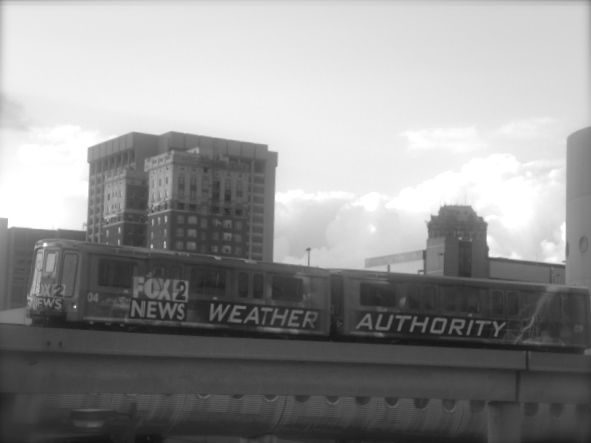
Let's start with transportation: as the auto capital of the world, Detroit is actually not a city that promotes public transportation, and the system it does have is limited. Our primary public transportation method is freeways. We have buses, but they are not rapid, and they are mapped out and set up in a way that can be difficult to adjust to for the new bus rider. Our only light rail is something we call the "People Mover".

The "People Mover" is 2.9 miles of single-track elevated trains encircling the business district of Downtown Detroit. With 13 stations at the largest buildings and commerce points in the city, it serves only a limited population, generally non-residents. In 1976, President Gerald Ford offered $600 million dollars to Southeast Michigan to build a rail transit system, and the only result was the People Mover. It was a competition to see who could build the most effective light rail transit system with the funds. It would seem that Detroit lost to its competitor, Miami. However, in recent news, Detroit plans to begin construction on the Woodward Light Rail Project which will connect to the People Mover, creating a more useful light rail system, which will also connect to the main passenger rail line, Amtrak.

                            
(Credit: Farley, Couper, Krysan, 2004)
To connect transportation to mobility is natural. We can now draw the line of transportation/mobility to class/mobility. Detroit is an incredibly poor city, we are considering bankruptcy as an option this year to solve some of our budget woes, and a financial state of emergency is in place. The city is poor, and the people are poor. A city with sharp racial divides - the city contains about 70% of all blacks in the Detroit Metropolitan region, and only about 5% of all whites. The staggering amount of poverty in the city is a sharp contrast to the suburbs as well. This causes incredible feelings of stress and hopelessness in regards to upward mobility for those who live in the city, and an equally incredible amount of privileged attitudes for those living outside the city.

The Renaissance Center (a.k.a. GM Headquarters) is located in the heart of Downtown Detroit. It is a symbol of hope to some, a symbol of automotive power to others, but to me, it is a symbol of Detroit's future mobility of both class and transport. As residents of Detroit, we rely on the automobile and its continued success and innovation. As the most visible building in Detroit it is one of the central stops of the People Mover. Rich and poor alike admire it, but only people with money will enter it to use its many features. However, the outdoor view is astounding, and the fountains along the river front outside of it are frequented by children from all over the city, visitors, and residents alike. 

I have found that something as simple as sharing space with someone who relates differently to the world makes us grow. If we can take these interactions and expand them, we might create new ways of becoming mobil in both socioeconomic status and transport. To examine all the elements of race, class, transportation, mobility could fill volumes. I am only briefly examining how these ideas are connected, and I invite you to share your thoughts.

Race, class, transportation, mobility: all are connected to our ability to move, interact, and develop as a city and as individuals. The fact that we are the Motor City, does not make us the Mobil City. But I think we're getting there.


Sincerely,


Kaity Nicastri,
Detroit Lover

To see this post in its original form (without all the cool linked tidbits), go to Urban Vignettes!

Tuesday, May 29, 2012

Detroit: A City of Firsts and Paradoxes

For the full beauty of this post, go to my Urban Vignettes Introductory Blog about Detroit.


Detroit is a city of firsts. Most people in present times take autos for granted, but Detroit birthed the auto, the bus, the motorcyle. We had the first stoplight in the world, the first paved stretch of expressway, and the first motorcycle police officers. Henry Ford gave the first $5/day wage in an industrial position in order to stabilize his work force. We created malls [as we know them today], the sprawling suburbs were born out of having the luxury of vehicles available to most working families. We have influenced daily life around the industrialized globe.

We have a number of struggles and a reputation as one of the roughest, poorest cities if not in the nation, then definitely the Midwest. But if you scrape away the surface, you find a city that is full of fighters, lovers, artists, and people who truly value hard work. Our industries have faded, yet the city is searching for ways to stay afloat and create new industries and fields of economic growth. 

We are a city of paradoxes, of starting trends that spread out (Motown music, electronic music, Michael Jackson, Aretha Franklin, & Diana Ross come to mind...). Detroit is an unlikely urban farming and community gardening hotspot, but they are multiplying to combat a lingering food desert. The Motor City has a thriving biking community. The healthy food and the heart disease-causing food live within walking distance of each other. Our chefs are creative, affordable and approachable. 

 
Dinner at Sala Thai in Eastern Market

You can see our small but gorgeously uncluttered skyline from the shell of the Packard Plant, which closed in 1958 and was left to decay in nearly a mile long set of ruins:

Packard Plant 2012

Our story is one of birth, death and rebirth. We are a creative city: finding ways to make our way with scraps and memories and sheer determination. The world and suburbanites think we are dead city, but we are just an underground city - a city that deserves and requires a closer look. An intimate city, where you might eat next to a gallery owner or city official and have a conversation. A city looking from its past into its future. An international border town where the American dream came true for many immigrants and families.

Detroit River Walk facing Downtown Windsor & Detroit

I hope you are ready for a walk through the Motor City.

Sincerely,

Kaity Nicastri,
Detroit Lover

Tuesday, May 22, 2012

Urban Vignettes Bid for Detroit


This is my bid for Detroit to be in the new and very exciting blog: Urban Vignettes. 

I would like to bid for Detroit, MI. Our past, present and future are unique as an industrial & post-industrial city, and one picture I would like to share is from Detroit's oldest neighborhood, Corktown. This neighborhood is a symbol of stabilized neighborhoods in a city where most neighborhoods are unstable and suffering from depression and housing issues. It has maintained its value and its neighborhood spirit for nearly two centuries.

Another picture I would say is a defining feature of Detroit is that the "Detroit River" is an international waterway dividing the U.S.A. from Canada. This waterway includes several parks belonging to one country or the other and is spanned by the only known, privately held international bridge in the U.S.A. The Detroit River Walk is a public area for walking, running, biking or generally enjoying the skyline and waterfront.

Another unique feature about Detroit is the amount of repurposed materials used in art projects, building features, new buildings and neighborhood projects throughout the city. I am including a couple of interesting samples - one being a fountain made out of old sinks and a tube, and another is from the renowned Heidelberg Project on Detroit's East Side, initiated by Tyree Guyton (a local artist).


Let's take a stroll through Detroit together...