Showing posts with label Renaissance Center. Show all posts

Saturday, July 14, 2012

Urban Vignettes Week 6: Hope


A City of Hope

Detroit is a city that was built on hope, and continues to survive on hope. People move(d) here to find jobs in the auto industry, raise their families, and buy a home. They want(ed) better lives and to live "The American Dream". Despite setbacks, despite budgetary failure, despite economic collapse, hope has driven Detroiters to continue fighting and working to make their city into a better place. 

Mural featuring Joe Louis.
One of the symbols of the city is a large black fist, located at the head of Woodward, across from Hart Plaza. This fist represents Joe Louis, and his significance for the city and the African American community. Joe Louis grew up in Detroit, and was known as the most honest fighter in a time when corruption in the sport was rampant. He also fought for racial integration in golf, and was a symbol of equality for many. 

Bagley Pedestrian Bridge Sculpture
 The Bagley Pedestrian Bridge is a symbol on a much more local level, and represents the struggle of a city to unite. Bagley Street is a core street to the Southwest community near Mexican Town, and it was ripped in half by the construction of Interstate 75 in the 1970s. In 2010, the construction of a pedestrian bridge that connects the two sides of Bagley was completed. The piece was a symbolic win for the people of the neighborhood that felt their community was finally reunited in a physical way, with art pieces that spoke of the human struggle and the power of the area.

Detroit Renaissance Center & Skyline
The Renaissance Center crowns the Detroit skyline, and I always view it as a symbol of hope. The "RenCen" has been the tallest building in Michigan since 1977. I remember visiting it when I was a child, and marveling at the view over the river front, and it's circular floor plans. It means more to other people, and General Motors is not always the best symbol of hope, but their building is remarkable. It means that someone was willing to invest in Detroit and create a lasting monument to industry and the city's global impact.

Elementary School Children Playing Violins
Detroit has a new direction and hope: that creative industries will lead us into the future. Not only are creative industrial giants moving in, including Twitter, but we are teaching our youth art and creative thinking. This picture is of a small concert I attended where youth played their violins for an audience of primarily refugees. This struck me as the balance of many hopes: of hopeful refugees and asylees waiting to receive their legal status to begin new lives free of violence and oppression, of children's hope to be creative and successful in life, and the hope of parents that learning music will aid their children in the future, and the hope of a city that everyone can have an opportunity to pursue their dreams.

I hope that Detroit (i.e. Detroiters) never loses its hope and the ambition and courage to pursue its dreams.


Sincerely,

Kaity Nicastri,
Detroit Lover

If you want to see this post in its edited form, go to Urban Vignettes.

Friday, June 8, 2012

Urban Vignettes Week 1: Mobility in the Motor City

Mobility in the Motor City

Mobility is a word that has multiple meanings, I'm going to explore two: transportation and socioeconomic structure.

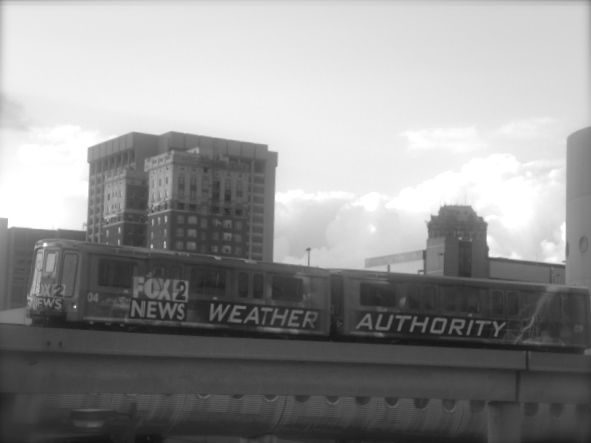
Let's start with transportation: as the auto capital of the world, Detroit is actually not a city that promotes public transportation, and the system it does have is limited. Our primary public transportation method is freeways. We have buses, but they are not rapid, and they are mapped out and set up in a way that can be difficult to adjust to for the new bus rider. Our only light rail is something we call the "People Mover".

The "People Mover" is 2.9 miles of single-track elevated trains encircling the business district of Downtown Detroit. With 13 stations at the largest buildings and commerce points in the city, it serves only a limited population, generally non-residents. In 1976, President Gerald Ford offered $600 million dollars to Southeast Michigan to build a rail transit system, and the only result was the People Mover. It was a competition to see who could build the most effective light rail transit system with the funds. It would seem that Detroit lost to its competitor, Miami. However, in recent news, Detroit plans to begin construction on the Woodward Light Rail Project which will connect to the People Mover, creating a more useful light rail system, which will also connect to the main passenger rail line, Amtrak.

                            
(Credit: Farley, Couper, Krysan, 2004)
To connect transportation to mobility is natural. We can now draw the line of transportation/mobility to class/mobility. Detroit is an incredibly poor city, we are considering bankruptcy as an option this year to solve some of our budget woes, and a financial state of emergency is in place. The city is poor, and the people are poor. A city with sharp racial divides - the city contains about 70% of all blacks in the Detroit Metropolitan region, and only about 5% of all whites. The staggering amount of poverty in the city is a sharp contrast to the suburbs as well. This causes incredible feelings of stress and hopelessness in regards to upward mobility for those who live in the city, and an equally incredible amount of privileged attitudes for those living outside the city.

The Renaissance Center (a.k.a. GM Headquarters) is located in the heart of Downtown Detroit. It is a symbol of hope to some, a symbol of automotive power to others, but to me, it is a symbol of Detroit's future mobility of both class and transport. As residents of Detroit, we rely on the automobile and its continued success and innovation. As the most visible building in Detroit it is one of the central stops of the People Mover. Rich and poor alike admire it, but only people with money will enter it to use its many features. However, the outdoor view is astounding, and the fountains along the river front outside of it are frequented by children from all over the city, visitors, and residents alike. 

I have found that something as simple as sharing space with someone who relates differently to the world makes us grow. If we can take these interactions and expand them, we might create new ways of becoming mobil in both socioeconomic status and transport. To examine all the elements of race, class, transportation, mobility could fill volumes. I am only briefly examining how these ideas are connected, and I invite you to share your thoughts.

Race, class, transportation, mobility: all are connected to our ability to move, interact, and develop as a city and as individuals. The fact that we are the Motor City, does not make us the Mobil City. But I think we're getting there.


Sincerely,


Kaity Nicastri,
Detroit Lover

To see this post in its original form (without all the cool linked tidbits), go to Urban Vignettes!